
Posey County Marriage Records
Posey County marriage license work is handled by the Clerk of the Posey Circuit/Superior Courts. The official Posey County marriage-license page says applicants first enter their information in the Indiana marriage portal. Both members of the couple then appear together at the Clerk's Office to complete the license. Appointments are not needed just to obtain a license, but an appointment is required if the couple wants to be married by the clerk.
Required items include state-issued identification, driver's license, birth certificate, or passport; Social Security number; and the correct fee. If an out-of-country birth certificate is used as identification, it must be officially translated. Once the license is issued, it expires after 60 days. After the ceremony, the completed license must be returned to the clerk as soon as possible so it can be recorded and used for certified copies.
The assigned marriage-license image comes from the official Posey marriage license instructions.
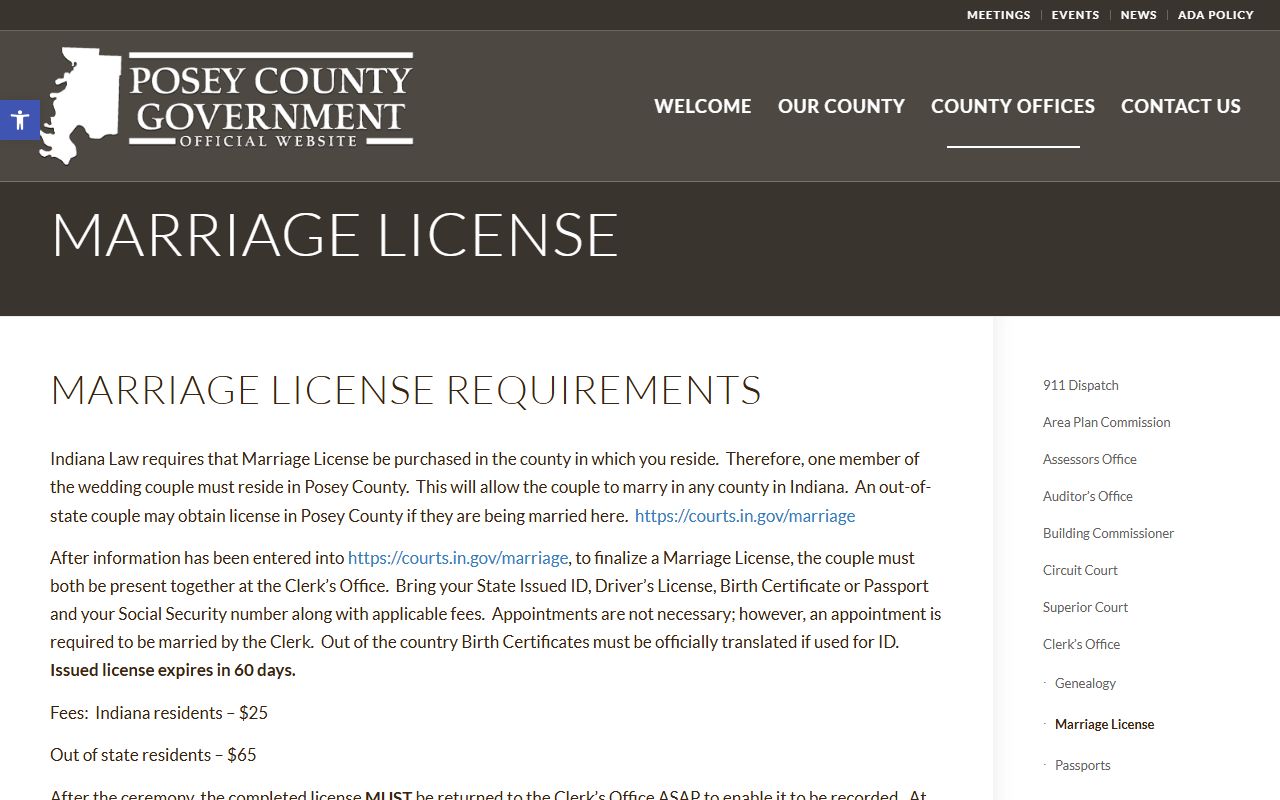
That county page is the local source for fees, copy instructions, and the in-person completion rule.
Apply for Posey County Marriage License
The marriage-license process has an online start and an in-person finish. The online application does not by itself issue the license. It gives the clerk the applicant information needed before both people appear together, show identification, provide Social Security information, and pay the correct resident or nonresident fee.
- Open the Indiana marriage application portal and enter applicant information before visiting the clerk.
- Gather acceptable identification, Social Security number information, and any translated foreign birth certificate if that document will be used.
- Both applicants appear together at the Posey County Clerk's Office to finalize the license.
- Pay the resident or out-of-state resident license fee listed by the clerk.
- Use the license before it expires and return the completed license after the ceremony so it can be recorded.
Note: An appointment is needed only when the couple wants the clerk to perform the ceremony.
Posey County Marriage Application Fields
The research file did not fully inspect each dynamic screen of the state application, but the official Posey process identifies the information and proof the clerk requires. Applicants should treat Social Security numbers and identity documents as private information and provide them only through the official state application and clerk visit.
| Field or Requirement | Type | Required | Notes |
|---|---|---|---|
| Applicant information in courts.in.gov/marriage | Web form | Yes | Entered online before the clerk visit. |
| Both applicants present | In-person requirement | Yes | Both people must appear together to finalize the license. |
| State ID, driver's license, birth certificate, or passport | ID document | Yes | A foreign birth certificate must be officially translated if used. |
| Social Security number | Identifier | Yes | Bring to the clerk and do not publish in a public request. |
| Residency status | Fee determinant | Yes | Indiana resident and out-of-state resident fees differ. |
| Clerk ceremony appointment | Appointment | Conditional | Required only if the clerk is asked to perform the ceremony. |
Posey County Marriage Fees
Posey County posts separate fees for Indiana residents and out-of-state residents. The clerk also lists the amount for a copy and the certification charge. Those copy and certification amounts are important after the ceremony, because a certified copy is the document many agencies use as legal proof that the marriage was performed and recorded.
| Item | Amount |
|---|---|
| Indiana resident marriage license | $25 |
| Out-of-state resident marriage license | $65 |
| Marriage-license copy | $1 per copy |
| Certification | $3 per certification |
| Divorce filing | $157 |
The clerk's posted marriage copy charges do not replace the need to confirm payment method and mailing rules before sending a request. A request by phone or email should include the names on the license, approximate marriage date, copy type, and requester contact information.
Posey County Marriage Copies
After the ceremony, the completed license must be returned to the Clerk's Office for recording. Only then can the clerk issue certified copies showing that the marriage was performed. The official county instructions say certified copies are issued after recording and that a copy request for a Posey County marriage license may be made by phone or email.
A practical copy request should identify both spouses as listed on the license, the date or approximate year, the number of copies, and whether certification is needed. If the couple recently married, the clerk may need to confirm that the completed license has been returned by the officiant or couple. For a name-change, benefit, insurance, passport, or immigration use, the requester should ask the receiving agency whether a certified copy is required.
Clerk of the Posey Circuit/Superior Courts
300 Main Street, Room 115
Mount Vernon, IN 47620
(812) 838-1306
kay.kilgore@poseycountyin.gov
Monday-Friday, 8:00 a.m.-4:00 p.m. CST
Posey County Divorce Records
Divorce records are court records, not vital-record certificates issued by a state health office. The Posey Superior Court page lists domestic relations with children and domestic relations with no children among its case types. The clerk fee schedule lists a divorce filing fee, and the county pages link users to Indiana Legal Help divorce forms. Public case status may be found in MyCase, while certified decree copies come from the clerk or court record channel.
The Superior Court FAQ gives two important local rules. At least one party must have lived continuously in Indiana for at least six months and in Posey County for at least three months right before filing. A final divorce hearing cannot be set sooner than 60 days after a Petition for Dissolution of Marriage is filed. If both sides fully agree on all matters, the divorce may be granted after that 60-day point. If they do not agree, the case is sent to mediation before a final or contested hearing can be scheduled.
| Topic | Posey County Rule or Source Detail |
|---|---|
| Residency | One party must have lived in Indiana for at least six months and Posey County for at least three months before filing. |
| Final hearing | No sooner than 60 days after the dissolution petition is filed. |
| Agreed divorce | May be granted after 60 days if all issues are resolved. |
| Contested divorce | Parties are ordered to mediation before a final or contested hearing is scheduled. |
| Filing fee | $157 under the clerk's fee schedule. |
Find Posey County Divorce Decrees
A divorce decree or order is located through the court case file. Search Indiana MyCase by party name or case number, then check whether the document is available online. If the decree is not public online, contact the clerk with the case number, party names, and copy type. Some family filings may be partly public while child-related, financial, protected-identifier, or sealed material is withheld or redacted under Indiana court access rules.
People sometimes ask the state vital-records office for divorce proof. The Indiana Department of Health marriage guidance points users back to the Clerk of Court in the county where the marriage license or divorce decree was issued. For Posey County, that means the local clerk and court file are the key channels for certified marriage copies and divorce decrees.
The assigned state vital-records image comes from the Indiana Department of Health marriage records guidance.
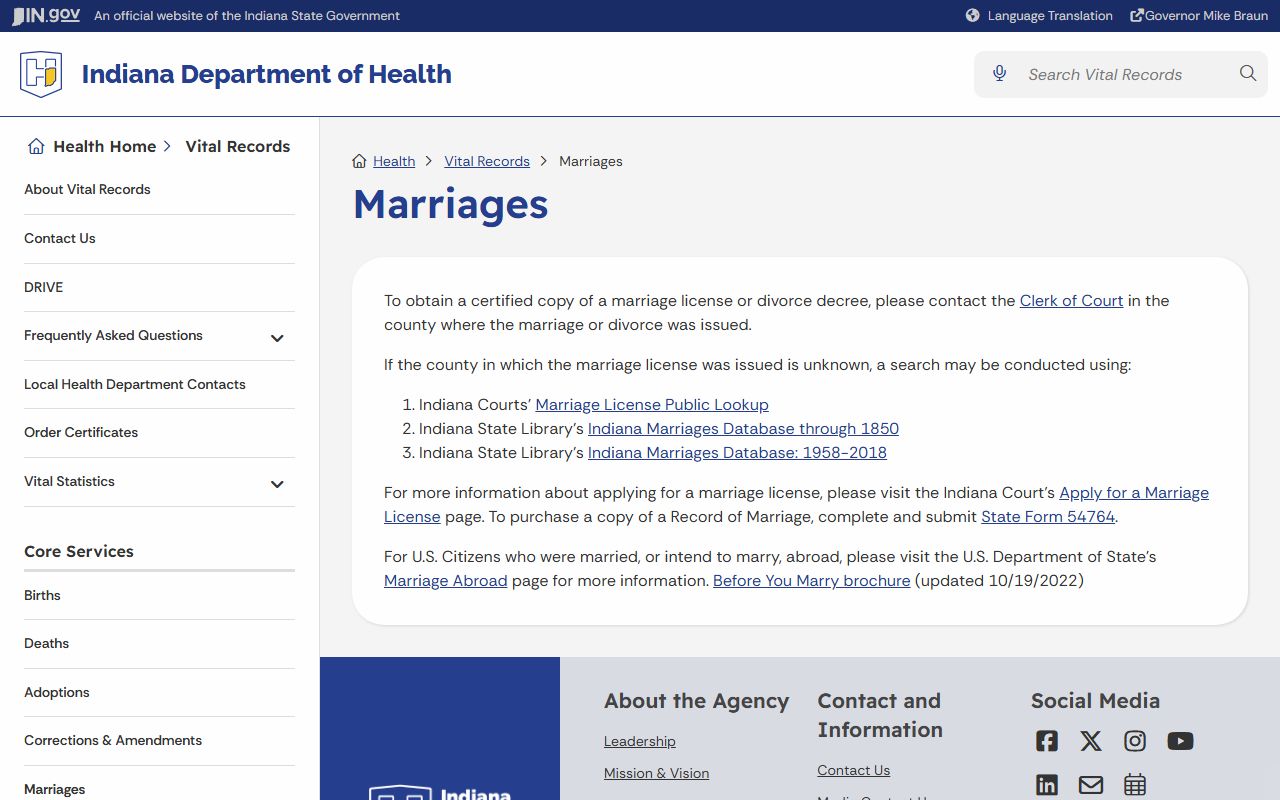
That state guidance confirms that county clerks, not the health department, issue certified marriage licenses and divorce decrees.
Restricted Posey County Family Records
Marriage-license copies are more direct than divorce case files because a divorce file can include sensitive facts. Public access may cover the case number, court, party names, filing date, status, hearings, orders, and some documents. It may not include protected identifiers, sealed exhibits, certain financial records, child details, or records restricted by court order. Adoption and CHINS records are not open like ordinary civil cases, and the Superior Court FAQ says CHINS hearings are closed to non-parties and non-attorneys.
When a record is restricted, the clerk may not be able to release it to a general public requester. A party, attorney of record, or person with a court order may have a different access path. The best request is narrow: identify the exact document needed and ask whether a public, certified copy is available. Broad requests for every family case document can be delayed or denied when confidential content is mixed into the file.